Trami Etiquette: The Sacred Rules of Sharing
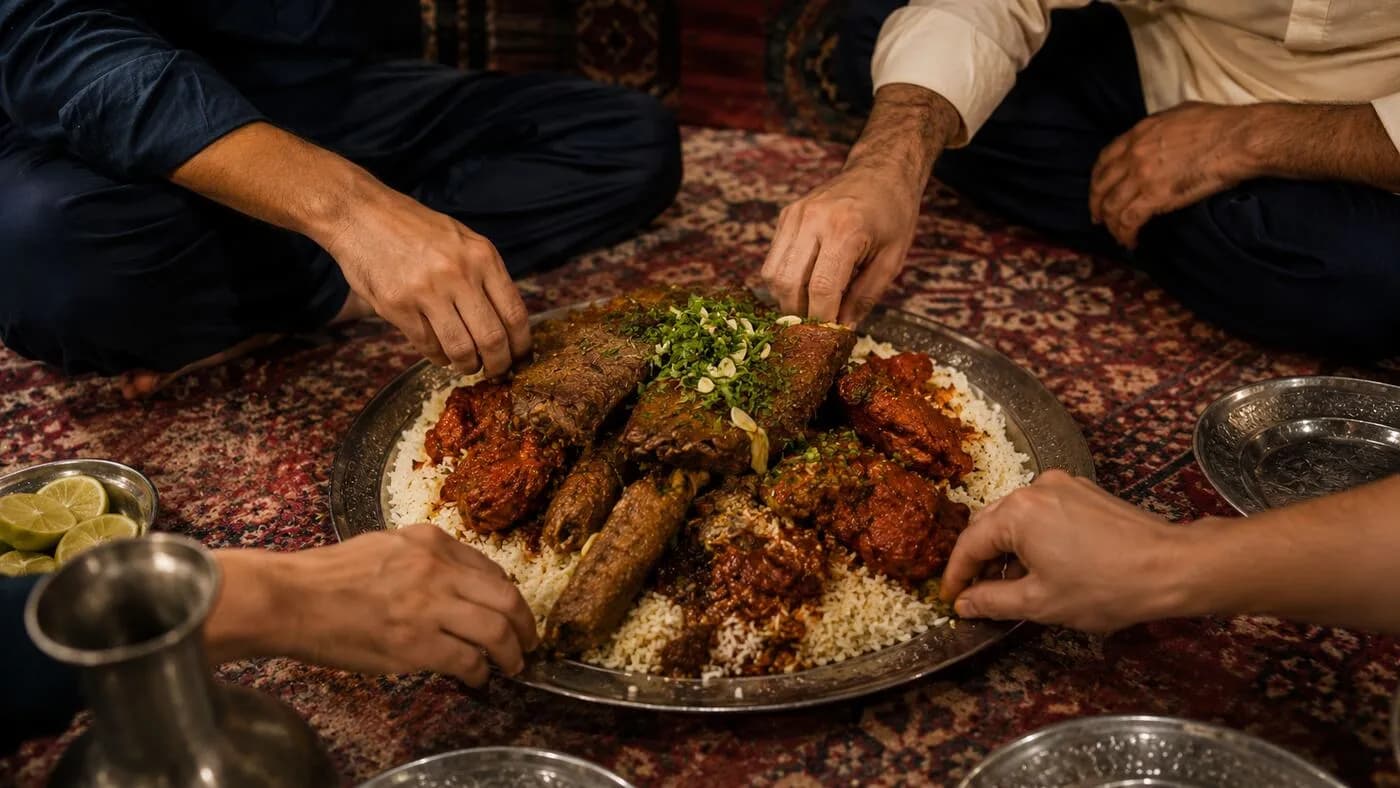
To experience a traditional Wazwan is to participate in a deeply communal and spiritual ritual. At the heart of this ritual is the Trami—a large, ornately engraved copper platter from which groups of four people eat together.
Eating from a Trami is not merely about sharing food; it is an exercise in equality, brotherhood, and respect. If you find yourself invited to a Kashmiri wedding, here are the sacred rules of the Trami you must observe.
1. The Washing of Hands (Tasht-naer)
Before the food arrives, attendants will walk through the seated guests with a Tasht-naer—a beautiful copper basin and pitcher. You must hold your hands over the basin while warm water is poured over them. Do not wash your hands with soap here, and try not to splash. Shake off the excess water gently; towels are rarely provided, as eating with slightly damp hands is traditional.
2. Groups of Four
The Trami is strictly designed for four people. You must sit cross-legged on the floor (usually on beautiful carpets covered by a white sheet called a Dastarkhwan). It is considered poor etiquette to start eating before all four people are seated at your Trami.
3. The Grand Entrance
When the Trami arrives, it is covered by a copper cloche called a Sarposh. Upon lifting the lid, you are greeted with a mountain of rice, sectioned by four Seekh Kababs, a whole roasted chicken (Waza Kokur), two pieces of Methi Maaz, and two pieces of Tabakh Maaz.
4. Dividing the Spoils
The first unwritten rule is division. The four Seekh Kababs acts as borders, dividing the rice into four quadrants. You must eat only from your quadrant. The central delicacies (the chicken, the ribs) are carefully pulled apart by the eldest or most respected member of the Trami and distributed equally among the four diners.
5. Eating with the Right Hand
As in many Eastern cultures, you must eat strictly with your right hand. You use your fingers to mix the rice with the various gravies that are served sequentially by the Wazas. Never use a spoon, and never use your left hand to touch the food or the platter.
6. Pace and Politeness
Wazwan is a marathon of 36 courses. Do not gorge on the early dishes, or you will not survive until the Gushtaba. Eat at a moderate pace, matching the rhythm of your Trami partners. It is polite to offer the best pieces of meat to the elders in your group.
7. Leaving the Trami
You cannot leave the Trami until all four people have finished eating. Leaving early is a grave insult to your fellow diners. When the final dish—the Gushtaba—is consumed, the Tasht-naer returns for the final hand washing.
To share a Trami is to share a bond. It dissolves boundaries of class and status, leaving only the shared joy of a majestic feast.